Buying guide
How to Hang a Hammock
As an Amazon Associate we earn from qualifying purchases. Our picks are researched from the manufacturers’ specifications and are our own editorial opinion.
On this page
Knowing how to hang a hammock comes down to three numbers and one rule. Hang it so the straps or ropes sit at about 30 degrees to the ground, keep the lowest point of the hammock around 18 inches up, space your anchors a little longer than the hammock, and only ever fasten to something solid: a living tree, a post set in the ground or a ceiling joist. This guide covers trees, rope, porches and posts, stands and indoor hangs, then ends with the safety checks that matter.
The setup that feels right is rarely the one that looks tight and neat. A hammock that is pulled flat puts far more force on its anchors and makes for a poor seat. A relaxed curve is safer and more comfortable, which is why the angle comes first in most setup guides.
The Hang Basics: Angle, Height and Distance
Three measurements decide how a hammock sits. Get them roughly right and the rest of the setup is routine.
The 30 Degree Angle
GearJunkie calls a 30 degree angle the optimal setup, measured between the strap and the horizontal with someone sitting in the hammock, and says there should be a slight dip even before you sit down. Trek Light Gear, a hammock maker, gives the same target and adds that pulling the hammock tighter increases the force on the anchors. If you are unsure, hang it a little looser than you think you need, then adjust.
How High Off the Ground
GearJunkie says to keep the lowest point of the hammock no more than 18 inches off the ground, which leaves enough clearance to get in and out. Trek Light Gear also suggests about 18 inches, roughly chair height, so you sit down into the hammock. Omni Calculator gives a slightly wider range of 16 to 19 inches. Bob Vila says a traditional hammock typically hangs 12 to 18 inches off the ground.
How Far Apart to Hang It
Trek Light Gear calls 10 to 15 feet between trees the sweet spot and notes that shorter gaps still work but leave the ends hanging lower. Omni Calculator suggests 12 to 17 feet. Both ranges are for ordinary gathered-end hammocks, so check your own hammock’s length and its manual before you pick two anchors. A spreader-bar hammock needs more room: Bob Vila puts it at about 13 feet between hanging points, with the hardware 4 to 5 feet off the ground.
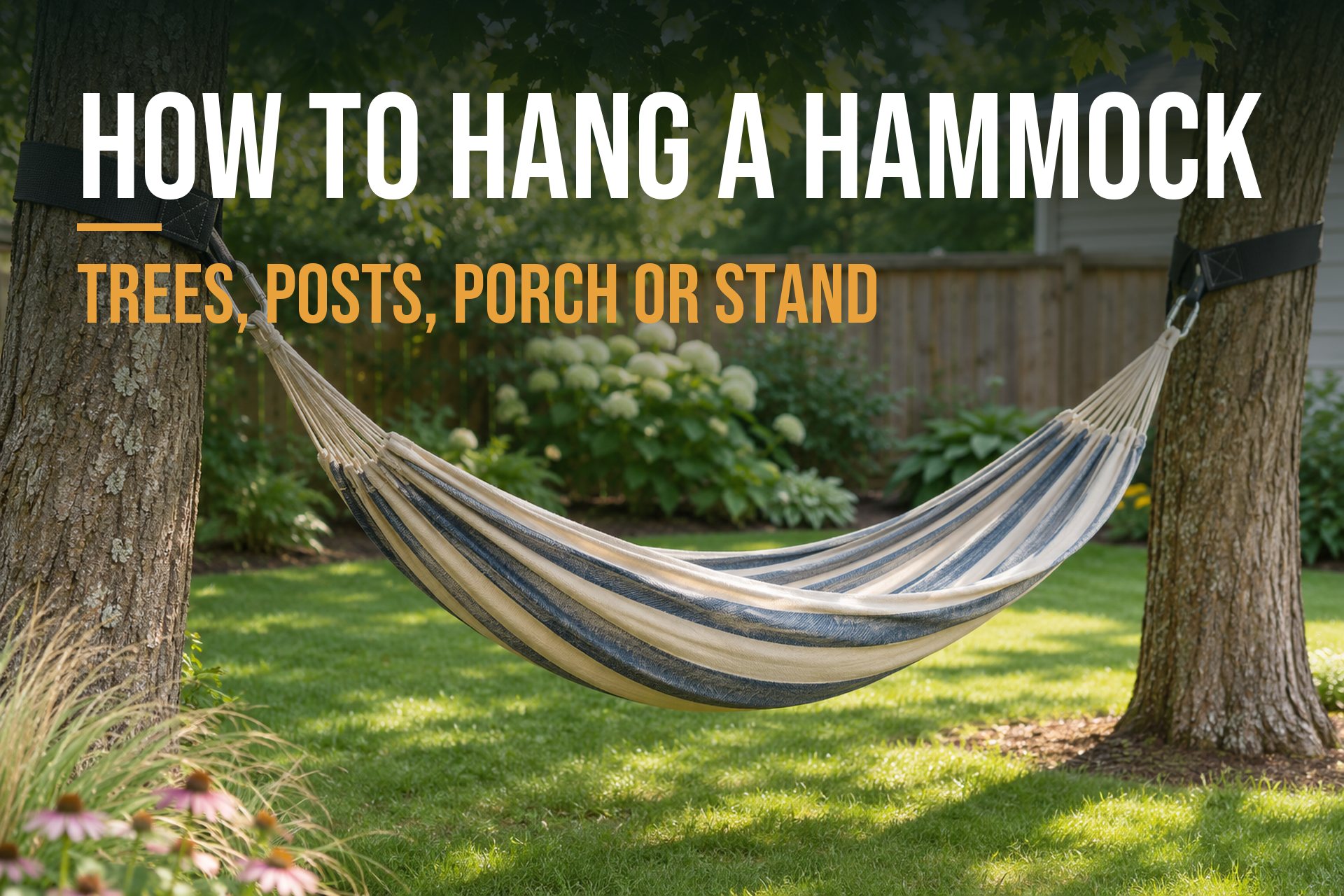
How to Hang a Hammock Between Two Trees
Trees are the classic anchors and the easiest to get wrong, because the tree is the part that can be hurt. Choose well, use the right straps and the hang takes about ten minutes.
Pick the Right Trees
The Leave No Trace Center says to use living trees at least 6 inches in diameter, preferably with hard bark, and never dead trees. Check above you for dead branches that could fall, hang on the thickest part of the trunk, and avoid trees that bend or stand in wet areas, because they can be uprooted. GearJunkie adds a rule that is easy to forget: never attach multiple hammocks to the same tree.
Straps Versus Rope
Use webbing, not bare rope. The Leave No Trace Center says to use straps made of webbing that are 1 inch wide or wider, to limit girdling and damage to the bark and the layer under it. GearJunkie says standard rope, wire or cord digs into the bark and damages the layers underneath, and notes that many parks require straps closer to 2 inches wide. Both sources say never to hammer or screw anything into a tree. For a first hammock, a set of long tree straps is the simplest purchase. Options include Wise Owl Outfitters 10 ft tree straps, Foxelli XL 20 ft straps and the ENO Atlas suspension system.
Step by Step
- Measure the gap. Check the distance between the trees against your hammock’s length and the ranges above.
- Wrap the strap once. Take each strap around the trunk at about head height or a little higher, on the thickest part of the trunk. Trek Light Gear suggests roughly 5 to 6 feet up the trunk. The Leave No Trace Center says to wrap the strap around the trunk once and not to wrap it several times or secure it with knots.
- Attach the hammock to each strap with the connectors your kit uses, following the maker’s instructions.
- Set the angle. Adjust the loops until the straps sit near 30 degrees and the hammock’s lowest point is about 18 inches up.
- Test low. Sit near the edge first, then settle in. Shorten or lengthen the straps if you can touch the ground too easily or if the angle looks flat.
The Leave No Trace Center also says the straps should hang a bit freely until you get in, because a tight hang can twist and squash the bark and the living layer under it.
How to Hang a Hammock With Rope
Rope makes sense when you are not tying to a trunk: a fence post, a pergola post or a metal pole, where there is no bark to protect. If your only anchors are trees, use straps. If you do tie rope, Backpacker’s guide to hammock knots names a simple, adjustable pair.
The Knots Worth Knowing
Backpacker recommends tying a bowline or a backpacker’s hitch to one end of the line and a taut-line hitch to the other, because you will always want to adjust the tension and a static knot will not allow it. It calls the bowline the more secure choice for attaching around the anchor, and advises wrapping the working end around the anchor at least twice so the rope does not slide down. A taut-line hitch relies on friction, so use it on ordinary rope and not on very slick cord.
When Not to Use Rope
Never use rope around a living tree trunk, per the sources above. Skip it too wherever a park, campground or homeowners’ association asks for tree-friendly straps. Whatever knots you tie, recheck them after the first few sits.
How to Hang a Hammock on a Porch or Posts
A porch can work as well as two trees, as long as the anchors are structural. Bob Vila says to fasten to wood studs, solid posts or ceiling joists, and warns that decorative elements are not built to carry the weight of a hammock. It also advises avoiding metal studs, because the load can bend them.
Joists and Beams
The porch ceiling is only a cover. Hunker’s indoor guide says to find the joists with a stud finder, mark the center of each and drill a small test hole: wood shavings in the bit mean you hit solid wood. Our guide on how to install a porch swing covers finding joists and checking the direction they run in more detail, and the same checks apply here.
Eye Bolts, Hooks and Chain
Bob Vila lists two wall anchors, eye hooks with attached J-hooks, or brackets with a built-in hook, paired with chain and S-hooks or carabiners so you can adjust the tension. Check the hammock maker’s stated capacity and make sure every piece of hardware can handle it. Bob Vila notes that many hammocks hold 300 or 400 pounds, though some go higher. Hunker says to use screw eyes long enough that at least 2 inches of shank sits in solid wood, and for heavier loads to add blocking between the joists with eye bolts passing through it, which it calls considerably stronger than screw eyes alone. Closed connectors, such as quick links or locking carabiners, are safer than open hooks.
Posts Set in the Ground
If you have one tree, Bob Vila suggests setting a post on the other side in a hole at least 2 feet deep with concrete, keeping it no more than 15 feet from the tree. For two posts, allow roughly the hammock’s length plus 2 feet between them. Never screw an eye hook into a tree.
Hanging a Hammock Without Trees
No trees, no posts, no joists? A hammock stand carries the load by itself and moves with you. The trade-off is floor space: a stand needs a long, clear footprint, and it is heavier to store than a set of straps. Two stands we link elsewhere on the site are the Sunnydaze universal heavy-duty hammock stand, which comes with chains, and the Amazon Basics 2 person portable hammock stand. For a full comparison by size and capacity, see our guide to the best hammocks with stand.
Stand or Frame
Match the stand to the hammock. Check the maximum length your stand will take and the weight rating of both, and set it on level, firm ground. A stand that rocks or sinks into soft soil is no safer than a bad tree.
Other Hanging Seats
If a hammock is more bed than you need, a seat that hangs from a frame may suit the space better. Our guides to the best hanging egg chairs, best patio swings and best porch swings cover frames and stands for sitting.
Can You Hang a Hammock Indoors?
Yes, if the anchors are real structure. Hunker’s guide to hanging a hammock from the ceiling uses two heavy-duty screw eyes, hammock chains and two carabiners, driven into joists, with the hanging points about 15 feet apart for a flat lie. Closer points give a deeper, basket-like shape.
Ceiling Joists
Hunker says to drill a 3/8 inch pilot hole and screw the eyes in as far as they will go. Do not hang from the drywall alone. If you cannot find two joists the right distance apart, add blocking or use a stand.
Walls and Frames
Wall studs can hold hammock hardware too, but the load pulls inward. One reader on a Permies forum thread about indoor hammocks warns that eye lag screws in wall studs can bow the wall out, so he hung his where reinforcement sits behind the wall. Many people simply use a floor stand indoors to avoid drilling at all.
Safety Checks Before You Climb In
Run through this list the first time and again each season. It takes two minutes.
Check the Anchors
- Trees: living, at least 6 inches thick, no dead branches overhead, no leaning or soggy ground.
- Posts and joists: solid wood, no rot, no wobble when you pull on the hammock.
- Hardware: closed connectors, rated well above the load, nothing bent or rusty.
Check the Hang and the Ground
- Angle near 30 degrees and the lowest point near 18 inches.
- A clear patch of ground, free of rocks, roots and sharp edges.
- Test with your weight low, near the ground, before you swing.
- Do not hang a hammock higher than needed. The Leave No Trace Center recommends staying under 5 feet off the ground to avoid accidents.
Take the hammock down when you leave. The Leave No Trace Center advises it to keep animals and small children from getting tangled, and to check local rules, because some parks prohibit hanging hammocks.
Frequently Asked Questions
Keep reading: Best Hammocks With Stand · How to Install a Porch Swing · Best Hanging Egg Chairs · Best Patio Swings · Best Porch Swings