Buying guide
How to Anchor a Gazebo Without Drilling
As an Amazon Associate we earn from qualifying purchases. Our picks are researched from the manufacturers’ specifications and are our own editorial opinion.
On this page
The answer to how to anchor a gazebo without drilling is weight on every leg. Fill sandbags or weight plates and strap them to the legs, or set each leg into a heavy planter or onto a concrete block. If the gazebo allows it, you can also tie the frame to a solid existing structure. Below are six methods, how to size the weight, and the point where drilling becomes the safer call.
Still choosing a gazebo? See our best gazebos guide, or compare it with a pergola in pergola vs gazebo.
Do Gazebos Need to Be Anchored?
Yes. A gazebo is a large, light roof held up by thin legs, and wind pushes on it like a sail. Without anchoring, a gust can slide the frame across a patio, tip it, or lift it. Makers tell you to secure the frame, and the instructions depend on the surface. The Aoxun hardtop, for example, says to fix it with ground spikes and wind ropes on grass and to bolt it down on a patio. The YOLENY hardtop ships with a pre-drilled base and expansion screws for concrete.
That is the catch for renters, owners of new pavers, and anyone with a deck or a sealed slab: the maker's default anchor is a drill. The methods below replace it with weight or with a fixing that does not pierce the surface. They work best on light frames. They do not change what the manual says about wind, so read it first.
How Much Weight per Leg?
There is no honest universal number. The right weight depends on the canopy size, the roof (fabric or hard), the height, how open the sides are, and how exposed your yard is. A maker who has tested a model gives a figure or ships the weights. Use that, and treat anything else as a minimum to beat.
Where to Find the Figure
Look in the printed manual, the product listing's "important notes" or care section, and the maker's support page. Pop-up canopy makers often specify weights per leg or include a set. The CROWN SHADES 10x10, for example, comes with 4 sandbags, 8 stakes and 4 guy ropes in the box. Hardtop makers usually specify bolts or ground anchors rather than weights, which tells you something about how they expect the structure to behave in wind.
What to Do If the Manual Gives No Number
Contact the maker and ask for the minimum anchoring per leg for your model. If they cannot give one, size the weights generously, fix all four legs equally, and treat the setup as fair-weather only. A single heavy leg and three light ones fails at the light ones.
6 Ways to Anchor a Gazebo Without Drilling
1. Sandbags and Leg Weights
The simplest method and the one canopy makers expect you to use. Weight bags fill with sand, gravel or water, and they strap or sit around each leg. Bags that wrap the leg and attach with straps hold better than loose bags leaned against it. Cast weight plates and steel leg weights do the same job in a tidier shape, and they do not split like cheap bags.
Use the same weight on all four legs, and check the bags after rain or a heat wave, because fabric degrades in sun and fill can leak out. This is the right first choice on concrete, decks and pavers because it touches the surface only at the bottom.
2. Planters
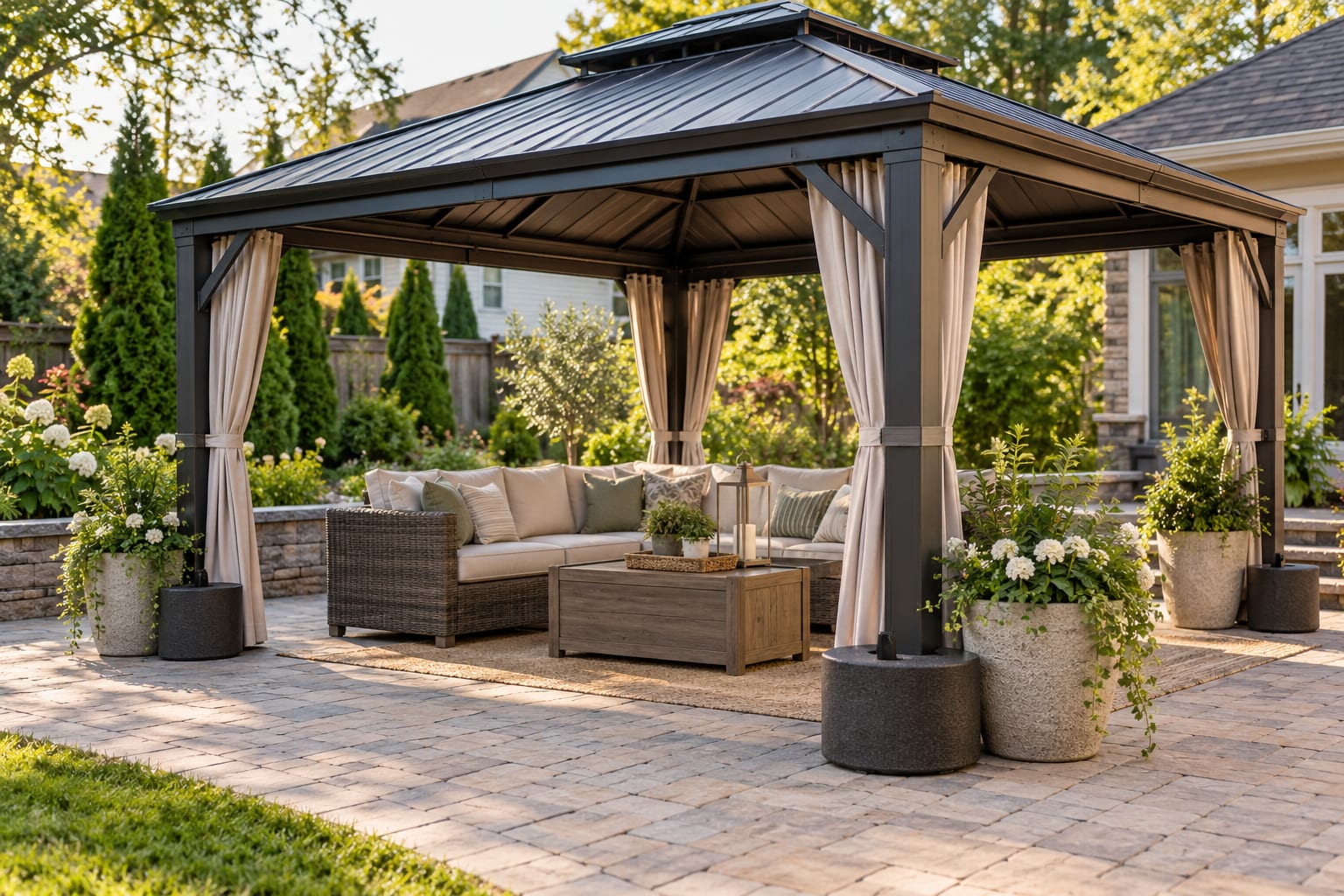
Many people ask how to anchor a gazebo using planters. A large planter filled with soil and wet plants is heavy, looks better than a bag, and can hide a leg. Two approaches work. In the first, place each leg inside a tall planter and pack the planter with soil or gravel so the leg cannot move. In the second, put a planter at each corner and tie the leg to its handle or rim with a ratchet strap or sturdy cable tie.
Pick planters with thick walls and a wide base. Thin plastic can crack and a tall narrow pot can tip as easily as the gazebo. Fill from the bottom with gravel or sand for weight, then top with soil. Planters are best for a permanent look on a patio or deck where the gazebo will stay put for a season.
3. Concrete Blocks and Movable Footings
To anchor a gazebo with concrete blocks, place a solid block at each leg and fix the leg to it. Cinder blocks are cheap, but they are hollow and light for what they do, so fill the cores with concrete or use solid pavers and footing blocks. Some people cast their own footings in buckets or small forms, with a post bracket or eye bolt set in the wet concrete, then place the gazebo leg on or against it.
The goal is a heavy base that the leg is physically tied to, not just near. A block that the leg can slide off does nothing. A strap, bracket or bolt through a cast eye is what turns it into an anchor. This method suits lawns and patios alike, and it can be moved, though not easily.
4. Heavy Pavers
If your patio is made of pavers, the surface itself is the issue: loose pavers can shift or lift, so tying a gazebo to one paver only anchors it to that paver. Instead, stack extra pavers or flagstones on and around each foot plate, and add straps from the leg to a weight sitting on the ground. Because the paver base is sand, drilling it also fails to give a hold, which is why weight is the better answer here.
Do not rely on a single paver being locked into the base. If you want a fixed anchor on pavers, a masonry contractor can set a footing beneath the paver layer, but that is not a no-drill job.
5. Strapping to an Existing Structure
If a deck rail, a fence post set in concrete, a masonry wall or another solid structure sits close, you can tie one or more gazebo legs to it with ratchet straps or steel cable. Use anchor points that are rated for the load, and keep the strap short and tight so the gazebo cannot build momentum before the strap takes up the slack.
This method suits gazebos next to a house or deck, but it adds loads to the structure you tie to, and a loose fence panel will not hold. Check what you are attaching to before you rely on it.
6. Adhesive Anchors (What Is and Is Not Known)
People ask whether glue, adhesive pads or epoxy can replace drilling. None of the gazebo makers above recommends adhesive pads or tape for holding a gazebo down, and neither do we: a gazebo pulls up and sideways in gusts, and a bonded pad on a patio surface is a weak point. Epoxy anchors used in masonry typically sit in a drilled hole, so they are not a no-drill answer either.
If a product claims a no-drill adhesive anchor for a gazebo, ask for the load rating and the surface it was tested on before you trust it.
Anchoring on Grass, Concrete and Pavers
The surface changes the best method, so match the two:
- Concrete: weights, planters and blocks all work, and the surface will not let a stake in. This is the case behind the common question of how to keep a gazebo from blowing away on concrete: add weight to every leg and tie the legs to it.
- Pavers: use extra weight rather than a single fixing, as covered above.
- Grass: stakes and wind ropes are the maker's method on a lawn, and the Aoxun manual says as much. If you cannot stake, use weights or buried footings, and expect the weights to sink into soft ground in rain.
- Decks: weights and planters spread load, but check the deck can carry them, especially planters full of wet soil.
Pop-Up Canopies vs Hardtop Gazebos
The two behave very differently in wind, and that decides how much a no-drill setup can do.
Pop-Up Canopies
A folding steel frame and a fabric top, designed to be weighted and staked, and to come down when the wind rises. Weights are the maker's normal method, so a no-drill setup is the intended one. Our pop-up canopy guide covers the models. The CROWN SHADES 10x10 Pop Up Canopy includes sandbags, stakes and guy ropes, and its maker says to take it down in high wind.
Hardtop Gazebos
A polycarbonate or steel roof is far heavier and stays up all year, so wind and snow loads are larger, and makers tend to specify bolts or ground anchors. The Aoxun 12x10 Hardtop Gazebo and the YOLENY 10x13 Hardtop Gazebo both ship with fixings for fastening down. Weights on a hardtop are a stopgap if the maker permits them at all, so ask before you rely on them. Our affordable gazebos guide covers lighter, lower-cost frames, which are the ones that need the most attention to anchoring.
When You Should Drill After All
Drill if any of these apply:
- The gazebo has a hardtop roof and the manual calls for bolts or anchors. Weights are not a substitute for a fixing the maker requires.
- It stays up through winter, storms or snow.
- Your yard is exposed to strong or gusty wind, such as open land, a hilltop or a gap between buildings.
- People will sit under it often, especially children, or it stands near a house, a fence or a parking space.
Anchoring a pergola raises the same question, and our best pergolas guide notes each maker's instructions. For both, follow the manual, and if you rent, ask your landlord about a small bolted footing: one set of holes in a slab is often easier to fix than a gazebo damage claim.
❓ Frequently Asked Questions
More on gazebos: best gazebos, pop-up canopy gazebos, affordable gazebos, best pergolas and pergola vs gazebo.