How to Hang a Little Tikes Swing
On this page
Here is how to hang a Little Tikes swing safely. Pick a solid overhead support, attach the swing with the hardware that ships with it, then set the seat height and the ground underneath to the maker’s instructions and the CPSC guidance. The steps below cover the three common supports (tree, porch beam and swing set frame), how a tire swing differs, and the safety checks to repeat every month.
This guide is written for the Little Tikes 2-in-1 Snug ’n Secure Swing, the bucket-style baby and toddler swing most parents mean. Your box and manual always come first.
What Comes in the Box
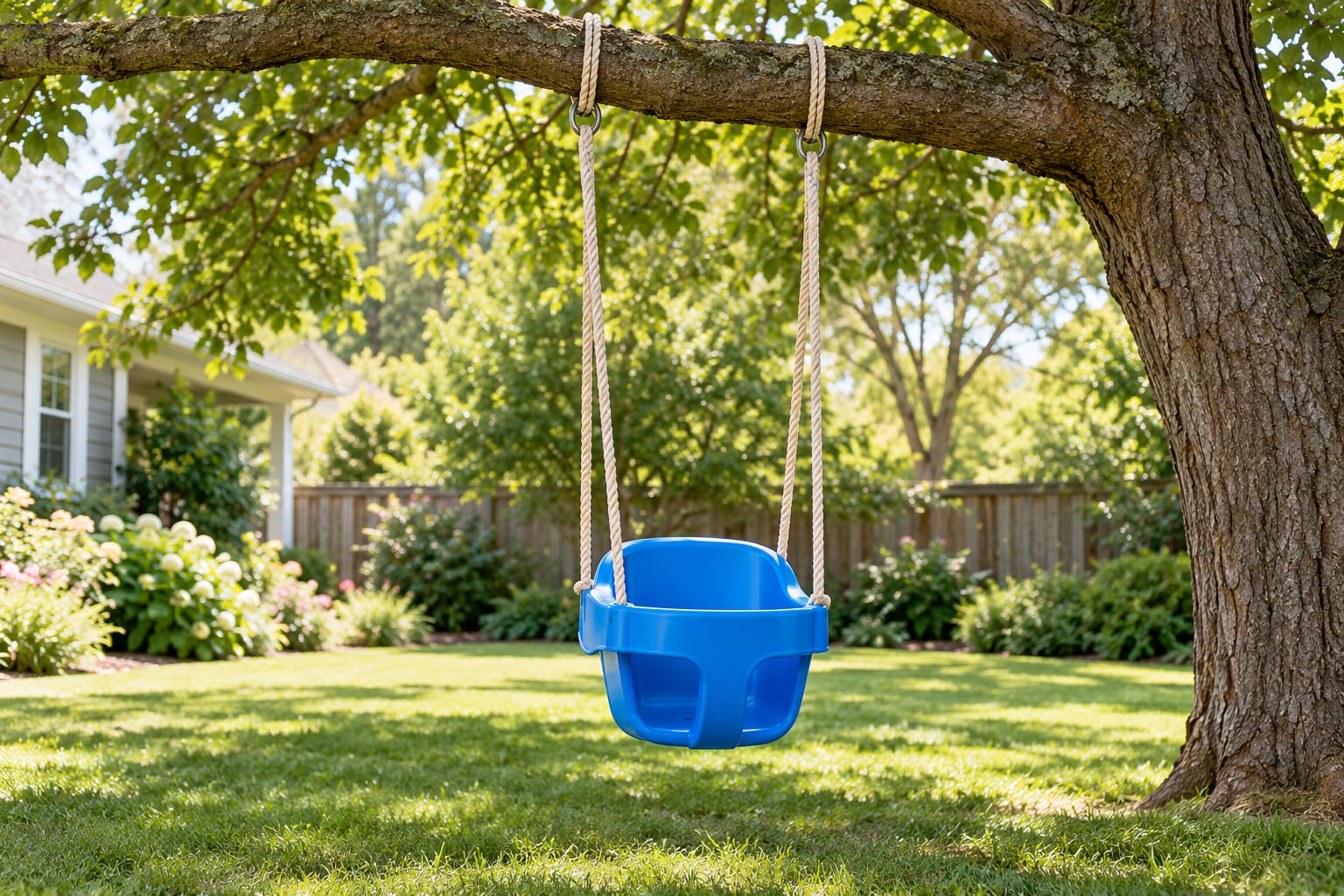
The Little Tikes 2-in-1 Snug ’n Secure Swing is a molded bucket seat with a T-bar that rotates down for loading and adjustable shoulder straps. When a toddler outgrows them, both move to the bottom of the seat, according to the Little Tikes product page. The same page gives the recommended ages as 9 months to 4 years and a maximum of 50 pounds. Treat the manual in your box as the final word.
Hardware to Check Before You Start
Lay everything out and look for the two ropes or chains with their hooks, the seat, the T-bar and the restraint straps. Check that nothing is cracked or frayed. The CPSC’s Outdoor Home Playground Safety Handbook says S-hooks must be closed so the gap is less than the thickness of a dime, and that open-ended hooks are acceptable only at the uppermost attachment point of a swinging element. If a hook arrives open, close it fully before the child gets in.
Hanging It From a Tree
A tree limb is the cheapest support, but it is also the one you cannot read from a spec sheet. Walk around the tree first. The tree should be established and healthy; cracks or splits in the trunk, dead or hanging branches and decayed spots are warning signs. If you have any doubt, get a second opinion from an arborist.
How Thick Should the Branch Be?
There is no engineering standard for a backyard limb, so thickness is only one test, and an arborist is the person to judge it. Pick a limb that is solid wood, grows nearly horizontal, and joins the trunk with a strong union. Skip anything with dead tips, cracks, missing bark or soft spots. A swing loads a limb with moving force, and sitting still on a branch tells you little about how it will behave under a swinging child.
Tree Straps vs Knots and Ropes
A rope or chain rubbing against a branch can wear away the bark and leave the tree open to insects and decay, and drilling an eye bolt wounds the limb. Wide tree straps spread the load over more bark and are easy to move or remove as the limb grows. Whatever you choose, do not tie your own knots on the part that carries the child unless the manual shows you how. Use the hooks and hardware the swing was made for, and check the wrap every few weeks so it never girdles the branch.
Hanging It From a Porch or Deck Beam
A covered porch looks like the perfect spot, with shade and an overhead beam. The catch is what the beam is. Hang the swing only from a structural beam or rafter you can identify, never from ceiling boards, trim or a decorative piece. If you are not sure what the framing is, ask a builder or inspector before you drill. Mount the hardware into the solid member, not just the surface.
Is Decking Under the Swing a Problem?
The CPSC handbook says not to install home playground equipment over concrete, asphalt or any other hard surface, because a fall onto a hard surface can cause serious injury. It also says grass and dirt are not protective surfacing. Decking is a hard surface too, so a swing that sends a child out over deck boards fails that test. If the beam is the only option, keep the swing path over a soft area beyond the deck edge or lay surfacing the handbook accepts.
Leave Room to Swing
The handbook says to keep play equipment at least 6 feet from any structure or obstacle such as a house, fence, shed, tree or pole, and farther to the front and rear of a swing: a distance equal to twice the height of the top bar. A porch wall or railing a few feet away does not meet that, so check your measurements before you commit.
Hanging It From a Swing Set Frame
A swing set beam is the easiest hang because it was built to carry swings. Slide the hooks over the beam hardware or use the swing’s own attachment, then confirm both sides sit at the same height and the seat hangs level. The CPSC’s Public Playground Safety Handbook recommends no more than two single-axis swings per bay, and says full bucket seats should hang from a separate structure or at least a separate bay, so give a toddler seat its own bay.
If you are still choosing a frame, our guides to the best swing sets and playsets and the budget swing sets cover sturdy options. Check the frame maker’s limits on swing weight and attachment before adding a second seat.
Adjusting the Height as Your Child Grows
Set the height so your child can be lifted in and out easily and the seat clears the ground comfortably when loaded. The Public Playground Safety Handbook, which covers playgrounds rather than backyards, puts the pivot point of a full bucket seat swing more than 47 inches and no more than 96 inches above the protective surface, and describes these seats as made for children under 4 with adult assistance. Use that range as context, and follow the Little Tikes manual for your seat.
As the child grows, move the T-bar and straps only when the manual says they are no longer needed, and re-check the seat height after any change. Little Tikes rates the 2-in-1 seat for 9 months to 4 years, so plan to move to a belt seat on the same frame afterwards.
What About a Tire Swing?
A tire swing is a different animal. The CPSC’s Public Playground Safety Handbook describes it as a multi-axis swing: usually three chains or cables from a single swivel, so the tire turns and swings in any direction. A Little Tikes seat is a to-fro swing on two suspending members, so do not hang it from a tire swing swivel.
Hardware and Space Differ
The same handbook says to pay special attention to the hanger on tire swings because failure is more likely with rotation and multiple riders, and it asks for 30 inches between the tire and the uprights of the structure and at least 12 inches from the seat to the ground. At home, the home handbook says to extend surfacing outward from a tire swing by the suspension chain length plus 6 feet. A tire swing needs a bigger, clearer space than a toddler bucket seat.
Safety Checks Every Parent Should Run
Hanging it right is half the job. The CPSC’s Outdoor Home Playground Safety Handbook gives the rest as a routine.
Surface and Safety Zone
- Keep at least 9 inches of loose-fill such as wood mulch, engineered wood fiber or shredded rubber mulch under equipment up to 8 feet high. An initial fill of 12 inches compresses to about 9 inches over time, so top it up.
- Extend the surfacing at least 6 feet in all directions, and for a to-fro swing, to twice the height of the top bar from which the swing hangs, in front and behind.
- Carpeting and thin mats are generally not adequate surfacing.
- Rake the surfacing from time to time to prevent compaction, especially under the swing where displacement is greatest.
Inspection Routine
- Check swing seats, ropes, chains and cables monthly for deterioration and replace them as needed.
- Check nuts and bolts twice a month and tighten them.
- Remove plastic swing seats in cold weather if the manufacturer recommends it.
- Never attach jump ropes, clotheslines, pet leashes or cords of any kind to play equipment.
Use and Supervision
The same handbook says never to leave a child in a toddler swing unattended, to fasten the child with the restraint system when one is provided, and to make sure the restraints do not let the child slide under or climb out. Our hammock with stand guide may suit a calmer spot in the same yard.
❓ Frequently Asked Questions
More for your yard: best swing sets and playsets, budget swing sets and hammocks with stand. More how-to help: our guides on how to level ground for a playset and how to install a porch swing.