Buying guide
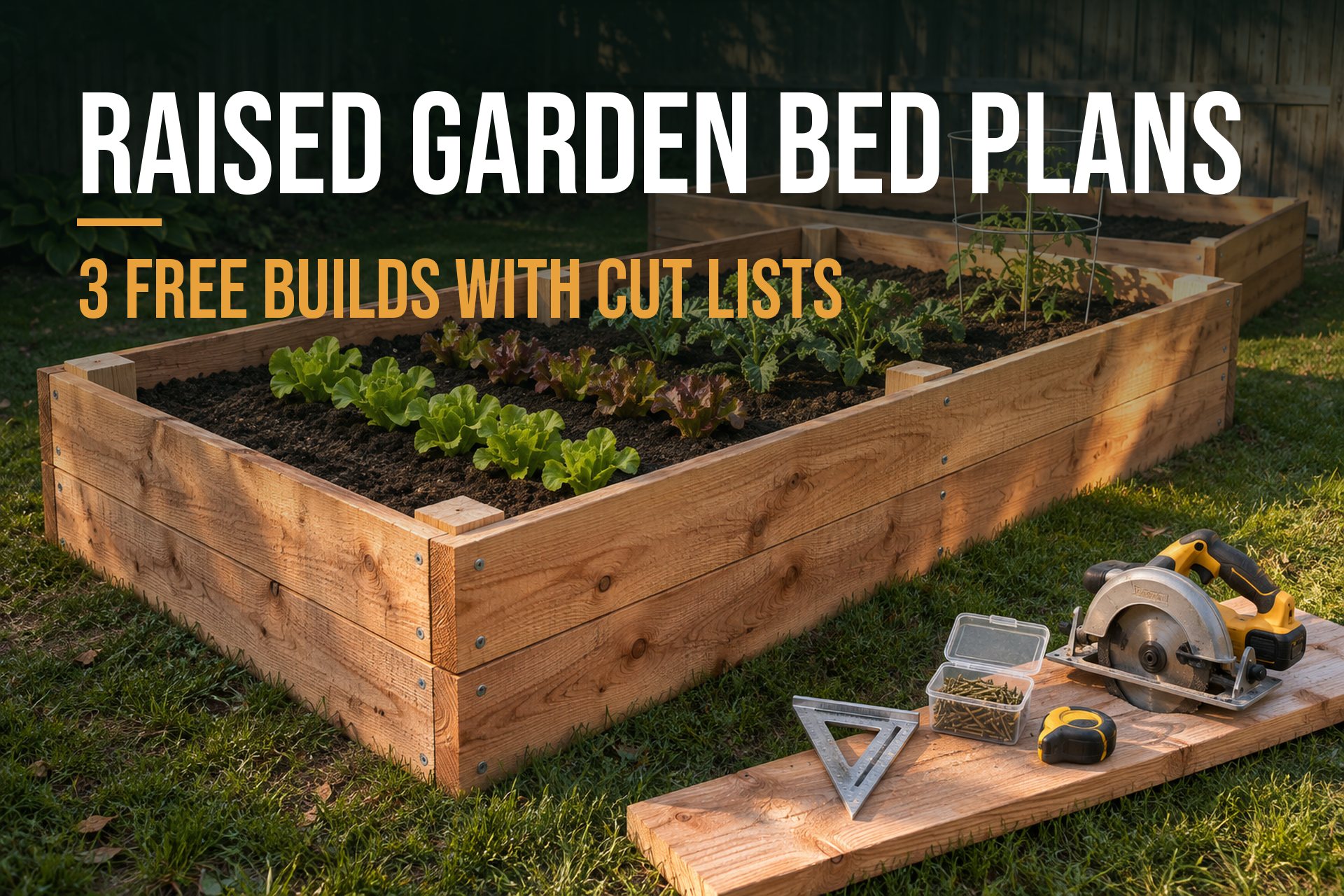
Raised Garden Bed Plans: 3 Free Builds With Cut Lists
As an Amazon Associate we earn from qualifying purchases. Our picks are researched from the manufacturers’ specifications and are our own editorial opinion.
On this page
These raised garden bed plans cover the three sizes most people build: a 4 x 8 ft bed, a 4 x 4 ft starter bed and a tall 2 x 8 ft bed for a patio edge or a fence line. Each plan has a drawing, a cut list, a shopping list and the soil it takes to fill. All three use the same parts (2x6 boards, 4x4 posts, exterior screws), one saw and one drill, and go together in an afternoon.
Which Raised Bed Plan Should You Build?
| Plan | Lumber | Soil | Best for |
|---|---|---|---|
| 4 x 8 ft, 11 in tall | 6 2x6, 1 4x4 | 26.2 cu ft | The classic vegetable bed |
| 4 x 4 ft, 11 in tall | 4 2x6, 1 4x4 | 12.6 cu ft | First beds, herbs, small yards |
| 2 x 8 ft, 16 1/2 in tall | 8 2x6, 2 4x4 | 17.9 cu ft | Patio edges, fences, less bending |
Want to compare other widths and lengths first? See raised garden bed dimensions. All boards are 2x6, sold as 8 ft lengths. A 2x6 really measures 1 1/2 x 5 1/2 in, and a 4x4 measures 3 1/2 in square, so the plans use those numbers. Soil volumes are the space inside the walls, less the posts.
Raised Garden Bed Plans With Cut Lists
Plan 1: The 4 x 8 ft Raised Bed
Two boards high, with a middle post on each long side. The size most vegetable gardens are planned around.
- Outside size8 ft x 4 ft
- Height11 in
- Soil to fill26.2 cu ft
- Lumber7 boards
| Part | Lumber | Cut to | Qty |
|---|---|---|---|
| Long side boards | 2x6 | 96 in | 4 |
| Short side boards | 2x6 | 45 in | 4 |
| Corner posts | 4x4 | 11 in | 4 |
| Middle posts | 4x4 | 11 in | 2 |
Shopping list
- 6 x 2x6 boards, 8 ft (cedar, or pressure treated rated for ground contact). The long sides use whole 8 ft boards: measure them and trim all four to the shortest one.
- 1 x 4x4, 6 ft long, for the posts
- 40 x #9 x 3 in exterior wood screws (coated or stainless), 2 per board end
- Optional: 1/2 in hardware cloth, 8 ft x 4 ft, for the bottom if gophers or voles are a problem
- Soil: 26.2 cu ft (0.97 cu yd), or about 20 bags of 1.5 cu ft with 10% extra for settling
Plan 2: The 4 x 4 ft Starter Bed
Four 8 ft boards, each cut into one long and one short side. The cheapest way to start, and easy to add a second one later.
- Outside size4 ft x 4 ft
- Height11 in
- Soil to fill12.6 cu ft
- Lumber5 boards
| Part | Lumber | Cut to | Qty |
|---|---|---|---|
| Long side boards | 2x6 | 48 in | 4 |
| Short side boards | 2x6 | 45 in | 4 |
| Corner posts | 4x4 | 11 in | 4 |
Shopping list
- 4 x 2x6 boards, 8 ft (cedar, or pressure treated rated for ground contact)
- 1 x 4x4, 4 ft long, for the posts
- 32 x #9 x 3 in exterior wood screws (coated or stainless), 2 per board end
- Optional: 1/2 in hardware cloth, 4 ft x 4 ft, for the bottom if gophers or voles are a problem
- Soil: 12.6 cu ft (0.47 cu yd), or about 10 bags of 1.5 cu ft with 10% extra for settling
Plan 3: The Tall 2 x 8 ft Bed
Three boards high and narrow enough to reach across from one side. Made for the edge of a patio or along a fence.
- Outside size8 ft x 2 ft
- Height16 1/2 in
- Soil to fill17.9 cu ft
- Lumber10 boards
| Part | Lumber | Cut to | Qty |
|---|---|---|---|
| Long side boards | 2x6 | 96 in | 6 |
| Short side boards | 2x6 | 21 in | 6 |
| Corner posts | 4x4 | 16 1/2 in | 4 |
| Middle posts | 4x4 | 16 1/2 in | 2 |
Shopping list
- 8 x 2x6 boards, 8 ft (cedar, or pressure treated rated for ground contact). The long sides use whole 8 ft boards: measure them and trim all four to the shortest one.
- 2 x 4x4, 6 ft long, for the posts
- 60 x #9 x 3 in exterior wood screws (coated or stainless), 2 per board end
- Optional: 1/2 in hardware cloth, 8 ft x 2 ft, for the bottom if gophers or voles are a problem
- Soil: 17.9 cu ft (0.66 cu yd), or about 14 bags of 1.5 cu ft with 10% extra for settling
How to Build a Raised Garden Bed
Tools: a circular saw or miter saw, a drill with a countersink bit, a driver bit for your screws, a tape measure, a square and a level.
- Pick the spot. Most vegetables want 6 to 8 hours of sun. Leave 2 ft or more between beds for a path, more if a wheelbarrow has to pass.
- Cut the parts. Follow the cut list. Cut all boards of one length at the same time so the bed comes out square.
- Build the long sides first. Lay the long boards flat, edges tight, and screw them to a post at each end (and the middle post on 8 ft beds). Drill pilot holes 1 in from the board ends so the wood does not split.
- Add the short sides. Stand the two long sides up and screw the short boards to the other face of the corner posts. Two screws per board end is enough.
- Square and level it. Measure both diagonals; when they match, the bed is square. Scrape soil from under the high corners until it sits level.
- Line the bottom. Staple hardware cloth across the bottom if burrowing animals are a problem, then lay cardboard over grass to smother it.
- Fill and water. Fill to about 1 in below the top, water well, and top it up once it settles.
Raised Bed Soil Calculator
Enter the size of your bed, or tap one of the plans. The calculator gives the soil in cubic feet, cubic yards (for a bulk delivery) and bags.
Raised bed soil calculator
Bagged raised bed mix is the easy route for one or two beds. For three beds or more, a bulk delivery of a cubic yard or two usually works out cheaper and saves carrying dozens of bags. If you mix your own, a common recipe is roughly 60% screened topsoil and 40% compost; skip plain garden soil from the yard, which packs down hard in a bed. Layers, amounts and what to put at the bottom are in how to fill a raised garden bed.
How Deep Should a Raised Garden Bed Be?
For most vegetables, 10 to 12 in of loose soil is plenty (the full height guide covers every crop), which is why two 2x6 boards (11 in) is the standard height. Go deeper for root crops, or when the bed sits on a patio, concrete or poor soil that roots cannot get into.
| What you grow | Soil depth | Build it with |
|---|---|---|
| Lettuce, salad greens, herbs | 6 to 8 in | One 2x8 or two 2x4s |
| Most vegetables: peppers, beans, squash, cucumbers | 10 to 12 in | Two 2x6s (11 in) |
| Tomatoes, carrots, potatoes, parsnips | 12 to 18 in | Three 2x6s (16 1/2 in) |
| Bed on a patio, concrete or hard clay | 16 in or more | Three 2x6s or more |
Best Wood for a Raised Garden Bed
- Cedar or redwood. Naturally resistant to rot and the usual choice for food beds. Expect many years out of a 2x6 cedar bed. See the cedar raised garden bed plans.
- Pressure treated lumber. Lasts longest for the money. Buy boards rated for ground contact. The old arsenic treatment (CCA) was phased out for residential lumber at the end of 2003, and today's copper based treatments are what you find in stores. If you would rather keep treated wood away from the soil, line the inside walls with plastic sheeting.
- Douglas fir or untreated pine. The cheapest, but expect them to rot within a few seasons where they touch wet soil.
- Avoid old railroad ties and any reclaimed wood you cannot identify.
Rather Not Cut Wood? Kits and Supplies Worth Buying
If you want the bed this weekend and do not own a saw, a kit gets you there. These are the ones we would pick for each of the plans above, and the best raised garden beds roundup compares more.

Greenes Fence Premium Cedar Raised Garden Bed, 4 x 8 x 17.5 in
The kit version of Plan 1, and taller: 17.5 in instead of 11 in. Greenes Fence makes it in the USA from untreated North American cedar, with 3/4 in boards that slide into dovetail slots in the corner posts, so it needs no tools. The posts are routed to stack a second kit on top or join beds end to end. The maker says it holds up to 46.7 cubic feet of soil, so budget for nearly twice the soil of our 11 in bed.
✅ Pros
- No cutting and no screws: boards slide into the corner posts
- Untreated cedar, the usual pick for food beds
- Stackable for a deeper bed later
❌ Cons
- 3/4 in boards are thinner than the 1 1/2 in 2x6s in our plans, so they flex more on the long sides
- At 17.5 in it takes almost twice the soil of Plan 1
Best For: gardeners who want a classic 4 x 8 ft cedar bed without buying lumber or tools.

Vego Garden 17 in Tall 9 in 1 Metal Raised Garden Bed, 8 x 2 ft
The metal take on our tall 2 x 8 ft bed. At 17 in tall, it is close to the 16 1/2 in of Plan 3, and the 9 in 1 kit can be set up as one of nine shapes, so you can fit it to a corner of the patio. Vego coats the steel in zinc, magnesium and aluminum (they call it VZ 2.0) and caps the top edges with rubber trim. It goes together with the supplied fasteners.
✅ Pros
- Will not rot, and no wood treatment questions
- Nine shapes from one kit
- Rubber edging and rounded corners, nothing sharp
❌ Cons
- The panels set the sizes: you cannot cut it to an exact length like a wood bed
- Metal sides warm up in full sun; keep the soil mulched and watered
Best For: patios and long-lasting beds, and anyone who wants a tall bed without building one.

Land Guard 1/2 in Galvanized Hardware Cloth, 48 in x 100 ft
If gophers or voles live in your yard, line the bottom of the bed before you fill it. At 48 in wide, this roll covers the bottom of Plan 1 and Plan 2 in one piece with no seams, and 100 ft is enough for many beds. It is 19 gauge hot dipped galvanized steel with a 1/2 in square mesh that roots grow through and burrowing animals do not.
✅ Pros
- 48 in wide: one piece covers a 4 ft bed
- 100 ft roll lines a whole garden of beds
- Hot dipped galvanized steel wire
❌ Cons
- Heavy roll, and cut edges are sharp: wear gloves
- More than you need for a single bed
Best For: any yard with gophers, moles or voles, under any of the three plans.
Keep reading: raised garden bed ideas, the raised garden bed layout guide, the cinder block raised garden bed, the best garden benches, deck boxes for garden tools and small patio furniture.