Buying guide
Cinder Block Raised Garden Bed: Block Counts, Layouts and Safety
As an Amazon Associate we earn from qualifying purchases. Our picks are researched from the manufacturers’ specifications and are our own editorial opinion.
On this page
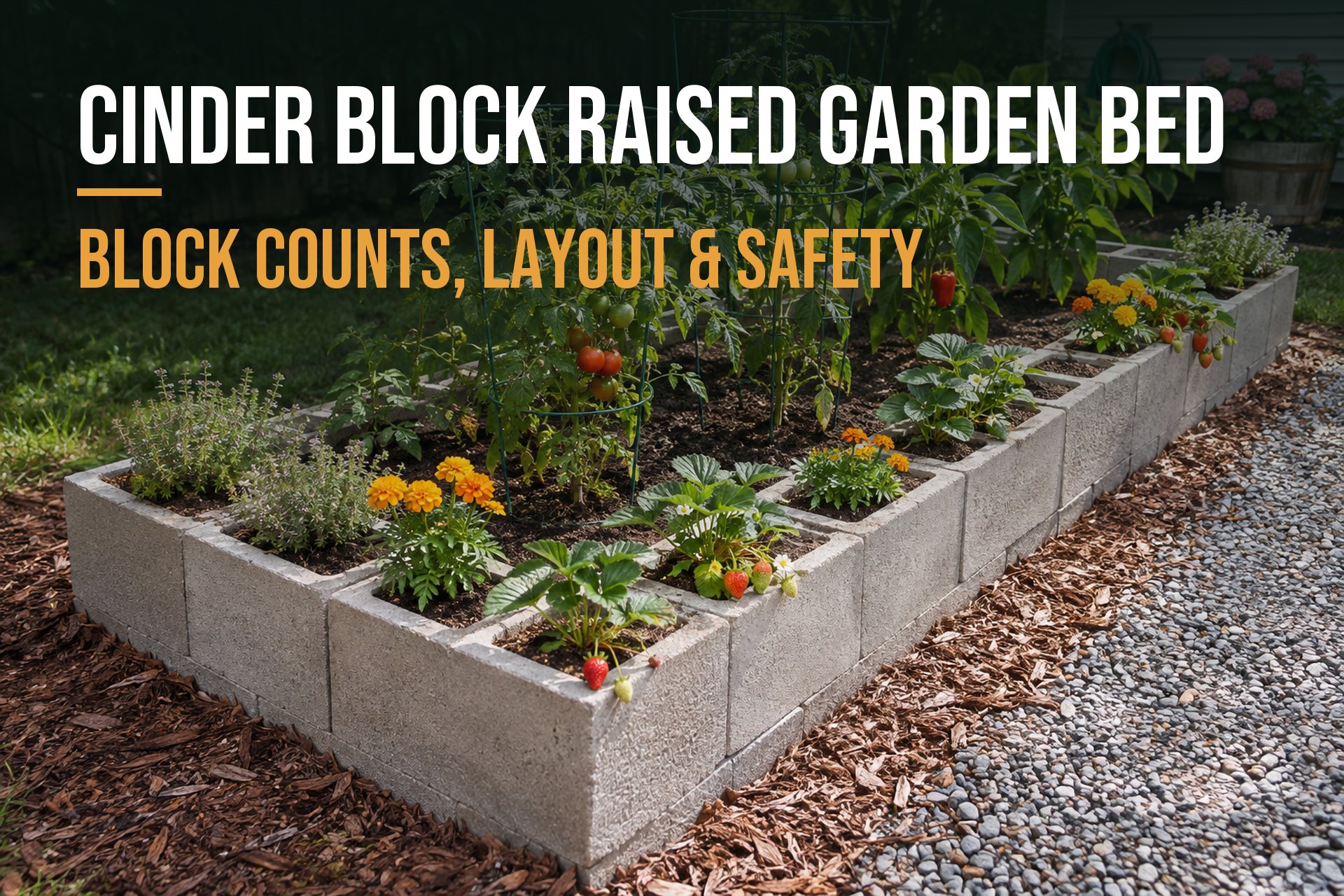
A cinder block raised garden bed is a ring of standard 8 x 8 x 16 in concrete blocks laid in a rectangle, one or two courses high, with soil inside and plants in the holes. A 4 x 8 ft bed one block high takes 16 blocks, and two courses take 32. No saw, no screws and no lumber: you level the ground, stack the blocks and fill. The plans below give the block count, a drawing and the soil for four sizes, and one section covers the question most people ask first: are cinder blocks safe for vegetables?
Which Cinder Block Bed Should You Build?
| Plan | Blocks | Soil | Best for |
|---|---|---|---|
| 4 x 8 ft, 1 course | 16 | 11.9 cu ft | Herbs, salad, strawberries |
| 4 x 8 ft, 2 courses | 32 | 23.7 cu ft | Tomatoes, peppers, beans |
| 2 ft 8 in x 6 ft 8 in, 2 courses | 24 | 9.5 cu ft | Narrow strip by a wall or fence |
| 4 x 12 ft, 1 course | 22 | 19.0 cu ft | A long, low bed for a whole garden |
A concrete block is sold as 8 x 8 x 16 in, but it measures 7 5/8 x 7 5/8 x 15 5/8 in, and the 3/8 in left over is the mortar joint. Laid dry, the blocks sit snug end to end and the bed comes out a hair under the sizes below. The sizes are set by the blocks: a bed is always a whole number of 16 in blocks long and wide, which is why the small plan is not a round 3 x 6 ft. If you want to compare widths first, see raised garden bed dimensions.
Cinder Block Raised Garden Bed Plans With Block Counts
Plan 1: The 4 x 8 ft Bed, One Block High
The simplest build: one course, 16 blocks, finished in an hour. The holes in the top take herbs and flowers.
- Outside size8 ft x 4 ft
- Height8 in
- Blocks16 blocks
- Soil to fill11.9 cu ft
| Part | Per course | Qty |
|---|---|---|
| Long side blocks (full length course) | 6 on each long side | 12 |
| Short side blocks (between them) | 2 on each short side | 4 |
| Blocks in one course | 16 | 16 |
| All 1 course | 16 x 1 | 16 |
Shopping list
- 16 x 8 x 16 in concrete blocks (about 560 lb in all, at roughly 35 lb each)
- Gravel for the base: about 3.6 cu ft of crushed stone, a 12 in wide strip 2 in deep under the walls
- Optional: 16 x 2 in solid cap blocks, 8 x 16 in, to finish the top
- Optional: 1/2 in hardware cloth, 6 ft 8 in x 2 ft 8 in, under the soil if gophers or voles are a problem
- Soil: 11.9 cu ft inside the walls, or about 9 bags of 1.5 cu ft with 10% extra for settling. Filling the block holes takes roughly another 3.2 cu ft
Plan 2: The 4 x 8 ft Bed, Two Blocks High
The same footprint, 16 in tall. Staggered courses and rebar pins hold it together, and the extra depth suits tomatoes and root crops.
- Outside size8 ft x 4 ft
- Height16 in
- Blocks32 blocks
- Soil to fill23.7 cu ft
| Part | Per course | Qty |
|---|---|---|
| Long side blocks (full length course) | 6 on each long side | 12 |
| Short side blocks (between them) | 2 on each short side | 4 |
| Blocks in one course | 16 | 16 |
| All 2 courses | 16 x 2 | 32 |
Shopping list
- 32 x 8 x 16 in concrete blocks (about 1,120 lb in all, at roughly 35 lb each)
- Gravel for the base: about 3.6 cu ft of crushed stone, a 12 in wide strip 2 in deep under the walls
- Optional: 6 x 1/2 in rebar pins, 24 in long, driven through the cores into the ground
- Optional: 16 x 2 in solid cap blocks, 8 x 16 in, to finish the top
- Optional: 1/2 in hardware cloth, 6 ft 8 in x 2 ft 8 in, under the soil if gophers or voles are a problem
- Soil: 23.7 cu ft inside the walls, or about 18 bags of 1.5 cu ft with 10% extra for settling. Filling the block holes takes roughly another 6.4 cu ft
Plan 3: The Small 2 ft 8 in x 6 ft 8 in Bed
Two blocks wide, so you can reach the whole bed from one side. Fits along a fence, a wall or the edge of a patio.
- Outside size6 ft 8 in x 2 ft 8 in
- Height16 in
- Blocks24 blocks
- Soil to fill9.5 cu ft
| Part | Per course | Qty |
|---|---|---|
| Long side blocks (full length course) | 5 on each long side | 10 |
| Short side blocks (between them) | 1 on each short side | 2 |
| Blocks in one course | 12 | 12 |
| All 2 courses | 12 x 2 | 24 |
Shopping list
- 24 x 8 x 16 in concrete blocks (about 840 lb in all, at roughly 35 lb each)
- Gravel for the base: about 2.7 cu ft of crushed stone, a 12 in wide strip 2 in deep under the walls
- Optional: 6 x 1/2 in rebar pins, 24 in long, driven through the cores into the ground
- Optional: 12 x 2 in solid cap blocks, 8 x 16 in, to finish the top
- Optional: 1/2 in hardware cloth, 5 ft 4 in x 1 ft 4 in, under the soil if gophers or voles are a problem
- Soil: 9.5 cu ft inside the walls, or about 7 bags of 1.5 cu ft with 10% extra for settling. Filling the block holes takes roughly another 4.8 cu ft
Plan 4: The 4 x 12 ft Bed, One Block High
A long, low bed: 22 blocks and nearly 19 cubic feet of soil. A good way to fill a sunny strip of lawn.
- Outside size12 ft x 4 ft
- Height8 in
- Blocks22 blocks
- Soil to fill19.0 cu ft
| Part | Per course | Qty |
|---|---|---|
| Long side blocks (full length course) | 9 on each long side | 18 |
| Short side blocks (between them) | 2 on each short side | 4 |
| Blocks in one course | 22 | 22 |
| All 1 course | 22 x 1 | 22 |
Shopping list
- 22 x 8 x 16 in concrete blocks (about 770 lb in all, at roughly 35 lb each)
- Gravel for the base: about 4.9 cu ft of crushed stone, a 12 in wide strip 2 in deep under the walls
- Optional: 22 x 2 in solid cap blocks, 8 x 16 in, to finish the top
- Optional: 1/2 in hardware cloth, 10 ft 8 in x 2 ft 8 in, under the soil if gophers or voles are a problem
- Soil: 19.0 cu ft inside the walls, or about 14 bags of 1.5 cu ft with 10% extra for settling. Filling the block holes takes roughly another 4.4 cu ft
Are Cinder Blocks Safe for Vegetables?
This is the question behind searches like "cinder block raised beds dangerous," so here are the facts. We are not making health claims, and the choice is yours.
- True cinder blocks are rare today. The name comes from blocks made with coal cinders decades ago. The blocks in a hardware store today are almost always concrete: cement, sand and gravel.
- Fly ash is the open question. Some concrete blocks include fly ash, a coal power plant byproduct, as a cement substitute. Some gardeners avoid any block that lists it, and the block maker can tell you what is in a pallet.
- Salvaged blocks are the real risk. A block pulled from an old building or a pile of unknown origin has an unknown recipe and an unknown history. Do not use those around food.
- Concrete can nudge soil pH up. Lime from the cement can raise the pH of the soil touching the wall. A cheap pH test kit after the first season shows whether it matters for your crop.
If you want no contact at all between soil and block, there is an easy option: line the inside of the bed with heavy plastic sheeting or landscape fabric, stapled under the top edge, before you fill it. It costs little and does not change any of the plans above. The planted holes stay open, so the lining only covers the inner wall.
How to Build a Cinder Block Raised Garden Bed
Tools: a flat shovel, a tape measure, a 4 ft level, a rubber mallet and gloves. Blocks weigh about 35 lb each, so ask for delivery to the spot or bring a wheelbarrow.
- Pick and clear the spot. Most vegetables want 6 to 8 hours of sun. Strip the grass, and leave 2 ft or more between beds for a path.
- Level the first course. Dig a shallow trench, about 2 in deep, tamp it flat and add the gravel base. Blocks on gravel stay level and drain, and they will not tilt as the ground thaws and soaks.
- Set the first course. Start at a corner, lay the long sides first, then fit the short sides between them. Check level along each side and across the corners, and tap the blocks into place with the mallet.
- Turn the corners. On the second course, flip the pattern: the short sides now run through and the long sides fit between. This staggers every joint over the block below it.
- Pin the walls. On a two course bed, drive a length of 1/2 in rebar through the cores at each corner (and along any long side) into the ground. Outdoor construction adhesive between courses is another way to lock them.
- Cap it (optional). Flat cap blocks cover the holes, give a clean top edge and make a seat. Leave them off if you are planting the holes.
- Line, fill and water. Lay cardboard over grass, add hardware cloth if burrowing animals are around, then fill to about 1 in below the top and water. Layers, amounts and what to leave out are in how to fill a raised garden bed.
Raised Bed Soil Calculator
Enter the inside size of your bed (outside size less 16 in in each direction), or tap one of the plans. The calculator gives the soil in cubic feet, cubic yards and bags.
Raised bed soil calculator
Planting the Holes in Cinder Blocks
The holes in the top course are small planting pockets, about 5 in across and as deep as the wall, each holding its own little pocket of soil. They suit shallow rooted plants that like to be a little dry:
- Herbs. Thyme, oregano, chives and parsley do well in the pockets and spill over the edge.
- Strawberries. One plant per hole keeps the fruit up off the soil, and the runners hang down the outside.
- Marigolds and nasturtiums. Bright edging that is often planted near vegetables.
Soil in the holes dries out faster than the bed, so water the pockets a little more often. Holes you are not planting can be filled with soil or gravel, or covered with cap blocks.
Cinder Block vs Wood Raised Beds
| Factor | Cinder block | Wood (cedar or treated 2x6) |
|---|---|---|
| Lifespan | Decades; blocks do not rot | Cedar many years, pine a few seasons |
| Weight | About 35 lb per block, hard to move later | Light enough to carry and rebuild |
| Effort | Lifting and levelling, no cutting | Cutting and screwing, much lighter lifting |
| Planting space | 16 in lost per dimension to 8 in walls | 3 in lost to 1 1/2 in boards |
| Soil and heat | Holds heat; can nudge pH up | Neutral; treated wood is a choice for some |
| Look | Industrial gray, planted holes soften it | Warm, the classic garden look |
Choose blocks if you want a permanent bed, have no tools or have a sloped site that needs a retaining wall too. Choose wood if you want a bigger planting area or may move the bed. Our raised garden bed plans give the wood version with cut lists, and some gardeners combine both, with blocks at the base and a wood course on top.
What Else Helps Block Beds
Concrete blocks themselves are not sold through Amazon, so this is the one supply worth ordering ahead: a barrier if gophers or voles live in your yard. For more layouts and styles, browse raised garden bed ideas.

Land Guard 1/2 in Galvanized Hardware Cloth, 48 in x 100 ft
Block walls stop burrowing animals at the sides, but nothing stops them coming up from below. This roll covers the bottom of Plan 1, 2 and 4 in one piece, since the inside of a 4 ft bed is only 32 in wide, with plenty left for the next bed. It is 19 gauge hot dipped galvanized steel with a 1/2 in square mesh that roots grow through and gophers and voles do not.
✅ Pros
- 48 in wide: one piece covers a 4 ft wide bed
- 100 ft roll lines many beds
- Hot dipped galvanized steel wire
❌ Cons
- Heavy roll, and cut edges are sharp: wear gloves
- More than you need for a single bed
Best For: any yard with gophers, moles or voles, under any of the four plans.
Keep reading: raised garden bed ideas, raised garden bed dimensions, how to fill a raised garden bed and the wood version, raised garden bed plans.