Buying guide
Best Electric Patio Heaters 2026
As an Amazon Associate we earn from qualifying purchases. Our picks are researched from the manufacturers’ specifications and are our own editorial opinion.

On this page
Editor’s Choice
DR. INFRARED HEATER 1500W Portable Infrared Indoor and Outdoor Heater
A 1500W carbon infrared heater that stands on a weighted, wheeled base or mounts to a wall or ceiling, with tip-over and over-temperature protection and a 12-hour timer.
-
Most powerful
DR. INFRARED HEATER DR-239 3000W Infrared Patio Heater
3000W of carbon infrared heat on a 220V-240V circuit, IP55 weatherproof, with wall and ceiling brackets for covered patios and commercial spaces.
-
Best tower heater
Haimmy 42" Outdoor Electric Patio Heater
A 42-inch freestanding tower with 9 heat levels from 620W to 1500W, an IPX5 rating, a child lock and tip-over shutoff.
An electric patio heater is the simplest way to take the chill off a porch, a covered deck or a screened patio: no propane tank to refill, no flame, no fumes, and warmth that arrives the moment you switch it on. We compared electric patio heaters in every common format, including freestanding infrared towers, tripod heaters, wall and ceiling mounted panels, a hanging lamp, and a high-output 240V model for bigger spaces. Our picks are researched from each manufacturer’s published specifications (wattage, voltage, weather rating, mounting, controls and safety features), and every spec in this guide comes from the maker’s own listing.
Weighing gas against electric? Our main guide to the best patio heaters compares freestanding propane models by BTU and heat range.
Best Electric Patio Heaters Comparison
| Product | DR. INFRARED 1500W EDITOR’S CHOICE | DR. INFRARED DR-239 3000W | Haimmy 42" Tower | Briza 1500W Tripod | EnerG+ Hanging |
|---|---|---|---|---|---|
| Image |  |  |  | 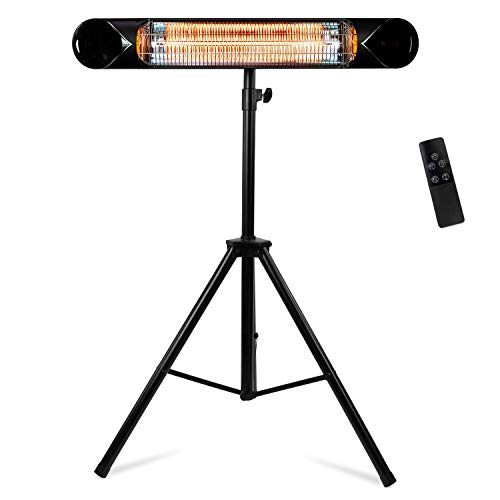 |  |
| Price | $$ | $$$ | $$ | $$ | $$ |
| Best For | Most patios and garages | Large covered patios | Freestanding on a deck | Tripod or wall use | Pergolas and gazebos |
| Max Power | 1500W | 3000W (10,260 BTU) | 1500W | 1500W | 1500W |
| Heat Settings | 900 / 1200 / 1500W | Power levels + standby | 9 levels, 620-1500W | 900 / 1200 / 1500W | 800 or 1500W |
| Voltage | Not stated | 220V-240V, NEMA 6-15P plug | Not stated | Not stated | Not stated |
| Mounting | Wheeled base, wall, ceiling | Wall or ceiling | Freestanding tower | Tripod, wall, ceiling | Hanging chain |
| Weather Rating | Not stated | IP55 | IPX5 | IP55 | IPX4 |
| Timer | Up to 12 hours | Not stated | 1-9 hours | 1-9 hours | Not stated |
| Safety | Tip-over and over-temp shutoff, ETL | Overheat protection, auto shutoff, ETL | Tip-over and overheat shutoff, child lock | Tip-over shutoff | Overheat cutoff at 185°F, ETL and cETL |
| Weight (maker) | 10.7 lbs | 7.6 lbs | 8.8 lbs | 6.6 lbs | 3.5 lbs |
| Availability | Shop Now at Amazon | Shop Now at Amazon | Shop Now at Amazon | Shop Now at Amazon | Shop Now at Amazon |
EDITOR’S CHOICE
DR. INFRARED 1500W
- Price
- $$
- Best For
- Most patios and garages
- Max Power
- 1500W
- Heat Settings
- 900 / 1200 / 1500W
- Voltage
- Not stated
- Mounting
- Wheeled base, wall, ceiling
- Weather Rating
- Not stated
- Timer
- Up to 12 hours
- Safety
- Tip-over and over-temp shutoff, ETL
- Weight (maker)
- 10.7 lbs
DR. INFRARED DR-239 3000W
- Price
- $$$
- Best For
- Large covered patios
- Max Power
- 3000W (10,260 BTU)
- Heat Settings
- Power levels + standby
- Voltage
- 220V-240V, NEMA 6-15P plug
- Mounting
- Wall or ceiling
- Weather Rating
- IP55
- Timer
- Not stated
- Safety
- Overheat protection, auto shutoff, ETL
- Weight (maker)
- 7.6 lbs
Haimmy 42" Tower
- Price
- $$
- Best For
- Freestanding on a deck
- Max Power
- 1500W
- Heat Settings
- 9 levels, 620-1500W
- Voltage
- Not stated
- Mounting
- Freestanding tower
- Weather Rating
- IPX5
- Timer
- 1-9 hours
- Safety
- Tip-over and overheat shutoff, child lock
- Weight (maker)
- 8.8 lbs
Briza 1500W Tripod
- Price
- $$
- Best For
- Tripod or wall use
- Max Power
- 1500W
- Heat Settings
- 900 / 1200 / 1500W
- Voltage
- Not stated
- Mounting
- Tripod, wall, ceiling
- Weather Rating
- IP55
- Timer
- 1-9 hours
- Safety
- Tip-over shutoff
- Weight (maker)
- 6.6 lbs
EnerG+ Hanging
- Price
- $$
- Best For
- Pergolas and gazebos
- Max Power
- 1500W
- Heat Settings
- 800 or 1500W
- Voltage
- Not stated
- Mounting
- Hanging chain
- Weather Rating
- IPX4
- Timer
- Not stated
- Safety
- Overheat cutoff at 185°F, ETL and cETL
- Weight (maker)
- 3.5 lbs
Electric Patio Heater Reviews
Each heater below fills a different role, because where the heater sits (on the floor, on a wall, or overhead) decides how well it warms the people around it. Specs are the manufacturers’ own; where a listing does not state something, we say so instead of guessing.
DR. INFRARED HEATER 1500W Portable Infrared Indoor and Outdoor Heater
The DR. INFRARED 1500W is our pick for most patios, porches and garages. Its flexibility is the reason: the maker supplies a weighted base with wheels so it can stand and roll across a deck, and it can also be mounted to a wall or a ceiling to free up floor space and aim the heat where people sit. The heating element is carbon infrared behind a mirror aluminum reflector that DR. INFRARED rates at 90% reflectivity, so the energy goes into people and furniture rather than into the surrounding air.
The remote switches between 900W, 1200W and 1500W, and a programmable timer of up to 12 hours shuts it off on its own. Safety is well covered: automatic tip-over protection, over-temperature protection, ETL certification, and a design that will not run unless the baseplate is installed. The housing is rust-resistant aluminum. The listing does not give a formal IP weather rating, so treat it as a heater for covered and sheltered spots rather than one to leave in the rain.
✅ Pros
- Freestanding, wall or ceiling mounting
- Three power levels and a 12-hour timer
- Tip-over and over-temperature protection
- Rust-resistant aluminum housing, ETL certified
❌ Cons
- No IP weather rating stated on the listing
- Voltage not stated on the listing
Best For: Covered patios, porches, garages and workshops where you want one heater that can move or be mounted later.
DR. INFRARED HEATER DR-239 3000W Infrared Patio Heater
The DR-239 is our pick when 1500W is not enough. It produces 3000W, which DR. INFRARED lists as 10,260 BTU, from a carbon infrared element in a long, slim housing that ships with both wall and ceiling brackets. The maker rates it IP55 weatherproof and pitches it for patios, garages, workshops, restaurants and shops, with ETL listing and built-in overheat protection with automatic shut-off.
The catch is the power supply. It runs on 220V-240V and comes with a NEMA 6-15P plug, which will not fit a standard household outlet. Most homes would need a dedicated 240V receptacle added near the mounting spot, which is a job for a licensed electrician. If you already have one (some garages and outdoor kitchens do), this is the strongest heater in our lineup by a wide margin.
✅ Pros
- 3000W, double the output of a 1500W heater
- IP55 weatherproof rating
- Wall and ceiling brackets plus remote
- Silent, odorless, no open flame
❌ Cons
- Needs a 220V-240V circuit and NEMA 6-15P outlet
- No freestanding option
- Timer not stated on the listing
Best For: Larger covered patios, outdoor kitchens and garages with a 240V circuit, or anyone who found a 1500W heater too weak.
Haimmy 42" Outdoor Electric Patio Heater
The Haimmy 42" is our pick for a freestanding tower heater. At 42 inches tall, with a heating tube that runs about two-thirds of its height, it warms you from the feet up rather than from a single hot spot, which suits people sitting in lounge chairs or at a low table. It uses a carbon fiber heating wire and offers 9 heat levels from 620W to 1500W, so you can run it low on a mild evening and turn it up when the temperature drops.
Haimmy covers the safety basics: a tip-over sensor that shuts it off if the wind or a pet knocks it over, overheat shutoff, and a safety lock that stops children or pets from switching it on by accident. A 1-9 hour timer, a remote and an IPX5 water resistance rating round it out. Because it heats with light and no fan, it runs silently.
✅ Pros
- 9 heat levels for fine control
- Tall heating tube warms the whole body
- Tip-over, overheat and child lock
- IPX5 water resistance and a remote
❌ Cons
- Takes floor space on a small balcony
- Voltage not stated on the listing
Best For: Decks, screened porches and terraces where a heater can stand beside the seating.
Briza Infrared Electric Patio Heater with Tripod
The Briza is our pick if you are not sure yet where the heater should live. It comes with an adjustable tripod stand for the patio and with hardware for mounting on a wall or a ceiling, so it can start on the tripod and move overhead once you know where people actually gather. The carbon infrared element warms surfaces and people directly, and the remote handles on and off, the three heat levels (900W, 1200W and 1500W) and the 1-9 hour timer.
Briza rates the heater IP55, which covers rain, snow, sand and dust, and builds in a tip-over sensor that shuts the unit off. That combination of a weather rating and a stand is less common than it should be among 1500W models.
✅ Pros
- Tripod stand plus wall and ceiling hardware
- IP55 weather rating
- Three heat levels, remote and 1-9 hour timer
- Tip-over shutoff
❌ Cons
- A tripod is easier to knock than a weighted base
- Overheat protection not stated on the listing
Best For: Renters and first-time buyers who want to try a spot before committing to a wall mount.
EnerG+ Infrared Electric Outdoor Heater, Hanging
The EnerG+ is our pick for a hanging patio heater. It hangs from a supplied chain, so you set the height to suit a pergola beam, a gazebo roof or a porch ceiling. The round infrared element runs at 800 or 1500 watts, and an aluminum reflector spreads the heat 360 degrees, which suits a round table or a seating group gathered under it.
The body is aluminum and stainless steel, and EnerG+ gives it an IPX4 rating, enough for splashes and damp air but not for direct, driving rain. It carries ETL and cETL certification, and an overheat cutoff switches the power off if the unit reaches 185°F. At 3.5 pounds it is by far the lightest heater here, which makes it easy to hang from a structure that could not hold a heavier panel.
✅ Pros
- Hangs at any height from a chain
- 360° heat for a table or seating group
- ETL and cETL certified with overheat cutoff
- Light at 3.5 pounds
❌ Cons
- IPX4 is the lowest weather rating in this group
- Remote and timer not stated on the listing
- Only two power settings
Best For: Pergolas, gazebos and covered porches with a beam or hook above the seating.
How to Choose an Electric Patio Heater
Most disappointment with an electric outdoor heater comes from a mismatch between the heater and the space: too little power for an open, windy deck, the wrong plug for the outlet, or a weather rating that does not match where it will hang. The checks below cover each of those.
Infrared Heat vs. Warm Air
Almost every electric patio heater sold for outdoor use is an infrared patio heater. Infrared warms the people and surfaces it reaches, the way sunlight does, instead of trying to heat the air, which a breeze carries away in seconds. That is why these heaters feel warm instantly and why aim matters: a heater pointed at the chairs works, a heater pointed at the open sky does not. Carbon elements, used by all five of our picks, give a softer glow than older halogen lamps.
Wattage and Coverage
A 1500W heater is the most you can run from a standard household circuit, and it is right for a group of two to four people within a few feet of it. For larger seating areas, use two 1500W heaters on separate circuits or step up to a 3000W model like the DR-239. Wind and an open sky reduce the felt warmth more than the wattage suggests, so a sheltered porch gets far more from the same heater than an exposed rooftop.
Voltage and Outlets
Check the plug before you buy. Plug-in 1500W heaters use ordinary outlets, while 3000W and larger models need a 220V-240V circuit, either through a special plug such as the NEMA 6-15P on the DR-239 or through hardwiring. Outdoors, use a GFCI-protected, weather-resistant outlet, avoid extension cords unless the manual allows a specific gauge, and have any new 240V receptacle or hardwired connection installed by a licensed electrician to local code.
Where to Put an Electric Outdoor Heater
Wall Mounted Patio Heaters
A wall mounted patio heater keeps the floor clear and puts the heat at an angle down onto the seating. Mount it on a solid surface, at the height and clearances the manual specifies, and angle it toward where people sit rather than toward the middle of the patio. Both DR. INFRARED picks and the Briza include wall brackets.
Ceiling and Hanging Heaters
A ceiling mount or a hanging patio heater warms a table or a seating group from above and stays out of reach of children and pets. It needs a roof, beam or pergola strong enough to carry it and an outlet within reach of the cord. Keep clear of fabric canopies and anything flammable by at least the distance the manufacturer lists.
Freestanding Towers and Tripods
Freestanding heaters move with you, which suits renters and anyone with more than one sitting area. Look for tip-over protection (the DR. INFRARED, Haimmy and Briza all have it), set them on a level surface, and route the cord where nobody will trip on it.
Weather Ratings and Safety
Reading IP Ratings
The IP code describes protection against dust (first digit) and water (second digit). IPX4 resists splashing water from any direction; IPX5 and IP55 resist water jets, and the 5 in the first position of IP55 adds dust protection. None of these ratings make a heater submersible, and a covered location still extends its life. If a listing gives no IP rating, as with our Editor’s Choice, keep it under a roof and bring it in when it is not in use.
Safety Features Worth Having
Tip-over shutoff, overheat protection and a timer are the three features that prevent most problems, and a recognized safety listing such as ETL shows the design was tested to a standard. Follow the manual for clearance from walls, ceilings and furniture, never cover the heater while it runs, and switch it off when nobody is around. Electric heaters produce no carbon monoxide, which is why they are the safer choice for screened porches; for gas models, our guide on whether propane heaters are safe indoors explains the limits.
Electric vs. Propane on a Patio
Electric heaters win on convenience, running cost per hour and covered spaces; propane wins on raw output and on open lawns far from an outlet. Many patios use both: an electric heater under the roof and a propane tower or a tabletop patio heater out in the open.
❓ Frequently Asked Questions
Conclusion
The right electric heater turns a cold covered patio into a room you can use from fall into spring. Match the wattage to the space, the plug to your outlet, and the weather rating to where it will live, then aim the infrared at the seating rather than the sky. For open yards where an outlet is far away, compare these with the propane models in our main guide to the best patio heaters, and for small tables, see our tabletop patio heaters.