Guide
Do Gas Fire Pits Keep You Warm? (The Surprising Truth)
As an Amazon Associate I earn from qualifying purchases. All claims are strictly my personal opinion.
On this page
- How Much Heat Do Gas Fire Pits Actually Produce?
- What Really Determines How Warm You’ll Feel?
- Gas Fire Pits vs. Wood-Burning: The Heat Comparison
- Understanding Propane vs. Natural Gas for Heat Output
- Will a Gas Fire Pit Keep You Warm in Winter?
- Gas Consumption: Is It Expensive to Run?
- Choosing the Right Gas Fire Pit for Heat
- Gas Fire Pits With Enough BTU to Keep You Warm
- Real User Experiences
- Frequently Asked Questions
- Conclusion
There’s nothing quite like settling into your outdoor space on a cool evening, only to realize the chill is making everyone retreat indoors. If you’ve ever wondered whether a gas fire pit can actually keep you warm, you’re not alone. The short answer is yes, but the full story is more nuanced than that. In this guide, I’ll walk you through what actually determines how warm your gas fire pit will feel, how it stacks up against wood-burning alternatives, and whether it’s truly effective for winter entertaining.
How Much Heat Do Gas Fire Pits Actually Produce?
The heating power of a gas fire pit comes down to one critical spec: BTU (British Thermal Unit) output. A BTU measures the amount of heat energy produced per hour. When evaluating whether a gas fire pit will keep you warm, understanding BTU ratings is essential.
Most residential gas fire pits range from 30,000 to 150,000 BTUs per hour, depending on size and burner design. A typical tabletop model sits around 30,000-60,000 BTUs, while larger fire pit tables and sunken installations can exceed 100,000 BTUs. To put this in perspective, research from FirePit Surplus notes that the right BTU output depends on your space size and how far guests sit from the flames.
What Really Determines How Warm You’ll Feel?
BTU output is just one piece of the puzzle. Several other factors affect whether you’ll actually feel cozy sitting around your fire pit.
Size and Burner Design
A larger fire pit with multiple burners distributes heat more evenly across a wider seating area. Fire pits with reflector plates, curved metal surfaces that bounce heat outward, amplify warming effect compared to open-bowl designs. The shape and materials matter as much as raw BTU output.
Wind and Weather Conditions
Wind is the silent heat thief. Even a gentle breeze can carry away warmth, making a 60,000-BTU pit feel lukewarm. Positioning your fire pit in a sheltered corner, against a wall, or in a recessed patio area dramatically improves its effectiveness. If your space is exposed, you may need a higher BTU rating to compensate.
Distance From the Flames
%22%2F%3E%3Ccircle%20cx%3D%22185%22%20cy%3D%22150%22%20r%3D%2210%22%20fill%3D%22%23e0f2fe%22%20stroke%3D%22%231e293b%22%20stroke-width%3D%221.5%22%2F%3E%3Ctext%20x%3D%22175%22%20y%3D%22185%22%20font-size%3D%2212%22%3E~3%20ft%3C%2Ftext%3E%3Ctext%20x%3D%22160%22%20y%3D%22200%22%20font-size%3D%2212%22%3EVery%20warm%3C%2Ftext%3E%3Ccircle%20cx%3D%22290%22%20cy%3D%22150%22%20r%3D%2210%22%20fill%3D%22%23e0f2fe%22%20stroke%3D%22%231e293b%22%20stroke-width%3D%221.5%22%2F%3E%3Ctext%20x%3D%22278%22%20y%3D%22185%22%20font-size%3D%2212%22%3E~10%20ft%3C%2Ftext%3E%3Ctext%20x%3D%22268%22%20y%3D%22200%22%20font-size%3D%2212%22%3ENoticeably%20cooler%3C%2Ftext%3E%3Cline%20x1%3D%22108%22%20y1%3D%2290%22%20x2%3D%22180%22%20y2%3D%2290%22%20stroke%3D%22%231e293b%22%20stroke-width%3D%221%22%20stroke-dasharray%3D%224%2C3%22%2F%3E%3Cline%20x1%3D%22108%22%20y1%3D%2290%22%20x2%3D%22108%22%20y2%3D%22150%22%20stroke%3D%22%231e293b%22%20stroke-width%3D%221%22%20stroke-dasharray%3D%224%2C3%22%2F%3E%3Ctext%20x%3D%22115%22%20y%3D%2285%22%20font-size%3D%2212%22%3EHeat%20radiates%20outward%2C%3C%2Ftext%3E%3Ctext%20x%3D%22115%22%20y%3D%22100%22%20font-size%3D%2212%22%3Eweakening%20with%20distance%3C%2Ftext%3E%3C%2Fsvg%3E)
Heat radiates outward and weakens with distance, just like sunlight. Sitting directly beside a fire pit feels significantly warmer than being 10 feet away. If your seating is arranged in a wide circle, guests on the far side will feel less warmth. Close, intimate seating arrangements maximize the heating benefit.
Material of the Fire Pit
According to Montana Fire Pits, material choice affects heat retention. Steel fire pits retain more heat than concrete, and both can reach 200-250°F on the rim during a hot burn. Darker colors absorb and retain more heat than lighter finishes, so a charcoal-gray steel pit will perform better than a light cream-colored concrete one.
Gas Fire Pits vs. Wood-Burning: The Heat Comparison
One of the most common questions I hear is whether gas fire pits deliver the same warmth as traditional wood-burning pits. The honest answer: it depends on the specific models you’re comparing, but they’re surprisingly close.
Research shows that over 80% of people with both types report feeling equally warm when sitting around either option. This is because well-designed gas burners produce steady, controllable heat. Wood fires, by contrast, are unpredictable: sometimes blazing hot, sometimes dying down as logs burn through.
Advantages of Gas for Heat
- ✅ Consistent heat output: no fluctuations as fuel burns
- ✅ Instant on/off control: turn heat up or down with a dial
- ✅ No smoke: guests stay comfortable without eye irritation
- ✅ Minimal maintenance: no ash cleanup or wood gathering
- ✅ Fuel efficiency: modern burners waste less energy than traditional fires
Advantages of Wood for Heat
- ✅ Potentially hotter flames: wood fires can reach higher radiant temperatures
- ✅ Iconic ambiance: crackling sound and visible logs appeal to many
- ✅ No fuel tank required: assuming you have wood readily available
For pure heating effectiveness in most residential settings, gas fire pits hold their own. The real deciding factor is often convenience and personal preference rather than raw warmth.
Understanding Propane vs. Natural Gas for Heat Output
Not all gas fuels deliver the same heat. Propane produces higher BTUs than natural gas in the same fire pit. According to The Fire Pit Store, natural gas has a lower BTU rating per unit volume, so if you’re connecting to a natural gas line, you may need a fire pit with a higher BTU rating to produce the same heat as a propane model.
If you have a choice, propane-fueled fire pits typically deliver more warmth in the same physical setup. This is worth considering if heating is your primary goal rather than ambiance alone.
Will a Gas Fire Pit Keep You Warm in Winter?
Yes, but with realistic expectations. A gas fire pit can add meaningful warmth to outdoor winter gatherings, but it shouldn’t be your sole heat source during genuinely cold weather.
For mild to moderate cold (50-65°F), a 40,000-60,000 BTU pit with good seating placement will keep you comfortable for hours. You’ll feel cozy without needing extra layers.
For deep winter (below 40°F), a gas fire pit works best as one layer of a warming strategy. Combine it with:
- Heavy blankets or heated throws
- Wind protection (a nearby wall, fence, or screen)
- Supplemental heat from an outdoor heater if available
- Close seating to maximize radiant heat
Think of a winter fire pit as atmospheric warmth plus functional heat: it creates ambiance while contributing meaningfully to comfort, but doesn’t replace proper clothing or additional heating for frigid conditions.
Gas Consumption: Is It Expensive to Run?
Many people worry that running a gas fire pit will spike their utility bill. In reality, modern gas fire pits are quite efficient. A typical 50,000-BTU fire pit running for 4 hours uses roughly 2-3 therms of propane or natural gas: a modest amount compared to home heating.
Running costs depend on local gas prices and frequency of use. For occasional weekend gatherings, the expense is negligible. Daily use during winter could add noticeably to your bill, but it’s typically less expensive than heating a large interior space.
Choosing the Right Gas Fire Pit for Heat
If warmth is your priority, focus on these specs when shopping:
- BTU rating: Aim for at least 50,000 if you plan winter use; 30,000-40,000 is fine for spring/fall entertaining.
- Burner design: Multiple burners and reflector plates improve heat distribution.
- Size: Larger fire pits heat wider seating areas; smaller tabletop models warm only close proximity.
- Fuel type: Propane delivers more consistent high heat; natural gas is convenient if you already have a line.
- Wind resistance: Look for designs that shield the burner and flame from gusts.
For dedicated winter use, consider an enclosed gas fire pit with glass screens: these contain heat better than open bowls.
Gas Fire Pits With Enough BTU to Keep You Warm
This section is by The Patio Pro team.
Applying the checklist above: these three propane models sit at 50,000 BTU or more, the level this guide suggests for winter use. They are chosen from the manufacturers' specifications. For side-by-side comparisons, see our guides to fire pit tables and portable fire pits.
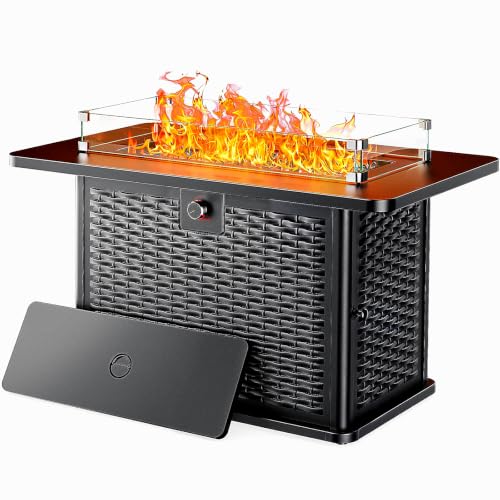
Ciays 43-Inch Rectangular Propane Fire Pit (60,000 BTU)
Added by The Patio Pro team. Specs from the manufacturer's listing.
The most heat of the three: 60,000 BTU through a 304 stainless steel H-burner, which Ciays says produces a denser flame pattern. It also answers two points from the checklist above: a clear wind guard shields the flame from gusts, and the reflective glass stones replace plain lava rock. Flame height adjusts continuously, and the cover turns it into a table when the fire is off.
Best For: larger patios and colder evenings, where you want the 60,000 BTU this guide recommends for bigger spaces.

Outland Living Portable Propane Fire Pit, 19 Inch (58,000 BTU)
Added by The Patio Pro team. Specs from the manufacturer's listing.
Proof that heat is about BTU, not size: this 19-inch fire bowl is rated at 58,000 BTU per hour. It is CSA approved, needs no assembly, and comes with a 10-foot hose, an adjustable regulator and a lava rock set. Because it is small, you can move it to the most sheltered corner of the patio, which this guide says matters as much as the BTU number.
Best For: small groups sitting close to the fire, and anyone who wants to take the heat camping too.

Ciays 28 Inch Propane Fire Pit Table (50,000 BTU)
Added by The Patio Pro team. Specs from the manufacturer's listing.
A 28-inch, 50,000 BTU fire table that Ciays says warms a space 8 to 10 feet wide, a useful number when you plan how close the chairs go. It is CSA-certified, burns smoke-free, and hides a 20 lb tank underneath.
Best For: spring and fall evenings on a smaller patio, with seating in a tight circle.
Real User Experiences
I’ve spoken with dozens of homeowners about their gas fire pits, and the consensus is clear: they deliver genuine warmth when positioned and sized correctly. Most report being able to sit comfortably outside for several hours without feeling chilled, especially with a blanket nearby. The adjustable flame control is frequently praised: people love being able to dial heat up or down based on the evening’s temperature.
Common feedback: “It’s not a roaring bonfire heat, but it’s reliable and you always know what you’re getting.” That predictability is actually an advantage for many people planning gatherings.
❓ Frequently Asked Questions
Conclusion
A gas fire pit absolutely can keep you warm: the evidence is clear from both performance specs and real-world user experience. With a reasonable BTU rating (40,000-80,000 for most residential spaces), smart placement to block wind, and seating close enough to benefit from radiant heat, you’ll enjoy consistent, controllable warmth throughout your outdoor gatherings.
Your next step: Measure your patio, note the prevailing wind direction, and estimate typical guest seating distance. Use this information to choose a fire pit with appropriate BTU output. Then arrange seating close to the pit, add a few blankets for cooler evenings, and you’re ready to create a warm, welcoming outdoor space that extends your entertaining season from spring through early winter.